
Search Intent Explained: How to Know What People Really Want
By Startup Matricks Team
Contributor

When people search on Google, they are usually looking for something specific. They may want an answer, compare two products, find a service, or visit a particular website. If your content does not match that goal, even strong SEO optimization may struggle to attract the right visitors.
That is why understanding search intent is essential for SEO. It helps you create content that answers what users actually want instead of simply targeting keywords.
Quick Answer: What Is Search Intent?
Search intent is the reason behind a user's search query. It describes what someone expects to find when they enter a keyword into a search engine.
For example:
- "What is SEO?" → The user wants information.
- "Best SEO tools" → The user is comparing options.
- "Buy running shoes online" → The user wants to purchase something.
- "Google Search Console" → The user may want to reach a specific website or tool.
Understanding this difference helps businesses choose the right content format, keywords, and optimization strategy.
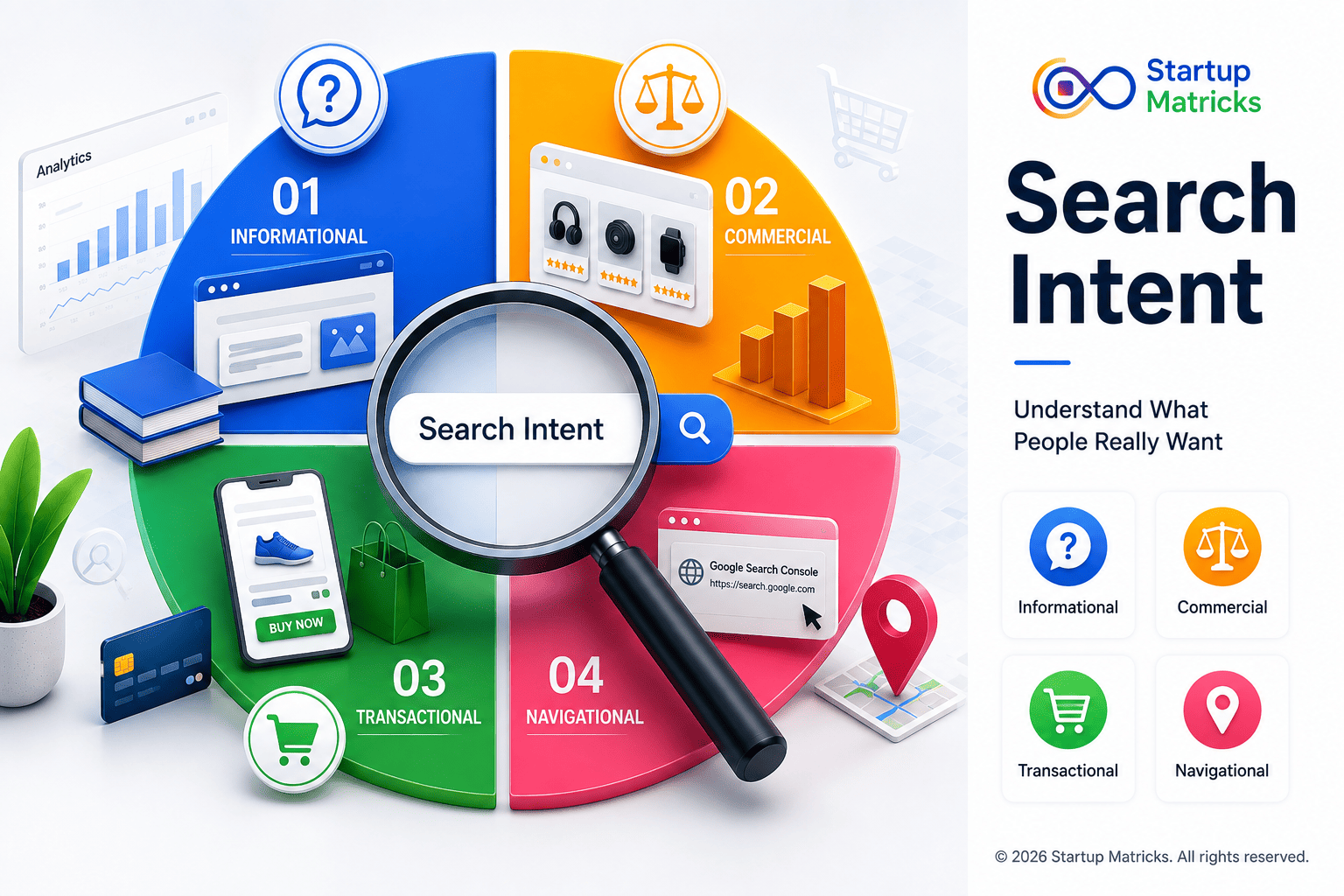
The 4 Main Types of Search Intent
Most SEO queries can be grouped into four broad categories.
1. Informational Intent
Users with informational intent want to learn or solve a problem.
Examples include:
- What is local SEO?
- How does Google Ads work?
- How to improve website speed
- SEO checklist for beginners
Best content formats: Blog posts, guides, tutorials, FAQs, and educational videos.
2. Commercial Intent
These users are researching options before making a decision. They may not be ready to purchase immediately, but they are evaluating solutions.
Examples:
- Best SEO company for startups
- SEO vs PPC
- Best email marketing tools
- WordPress vs Shopify
Best content formats: Comparisons, reviews, case studies, buying guides, and service comparisons.
3. Transactional Intent
The user is ready to take an action. That action could be purchasing a product, requesting a service, signing up, or booking something.
Examples:
- SEO services in Salem
- Buy domain name
- Google Ads management service
- Website development company
Best content formats: Service pages, product pages, landing pages, pricing pages, and signup pages.
4. Navigational Intent
The user already has a particular website, brand, or destination in mind.
Examples:
- Startup Matricks
- Google Analytics login
- Semrush
- Facebook Ads Manager
For these searches, users generally want to reach a specific destination rather than read a general educational article.
How to Identify Search Intent
You don't have to guess what users want. Start by examining the search results for your target keyword.
Look at the pages ranking on the first page and ask:
- What type of content dominates?
- Are most results blog posts, product pages, or service pages?
- What questions do those pages answer?
- Are comparison tables common?
- Is Google showing featured snippets or other SERP features?
- What information appears repeatedly?
For example, if most results for "search intent explained" are educational guides, creating a service page targeting that keyword would probably be a poor match.
The existing search results provide useful evidence about what Google believes users are looking for.
Search Intent Can Change
Search intent isn't always fixed.
A keyword may have different intent depending on the wording.
Consider "SEO tools."
A beginner searching "SEO tools" might want to understand what tools are available. Another user may be comparing platforms before subscribing.
Adding words such as best, pricing, review, buy, service, near me, or how to can significantly change the intent.
That's why you should analyze the complete query rather than looking at the keyword in isolation.
Why Search Intent Matters for SEO
Matching search intent can improve the usefulness of your content and help attract more qualified visitors.
A practical SEO strategy should align:
Keyword → Search Intent → Content Type → User Need → Business Goal
For example:
"What is local SEO?"
→ Informational
→ Educational blog
→ Explain the concept
"Local SEO services in Salem"
→ Commercial/Transactional + Local
→ Service page
→ Explain services and help users evaluate a provider
Creating a blog for the second keyword may not be the best choice if users primarily want to compare service providers.
Common Mistakes to Avoid
Targeting Keywords Without Understanding Intent
A keyword may have good search volume but still be unsuitable for your page.
Using a Blog for Every Keyword
Some searches require product, category, or service pages instead of articles.
Copying Competitor Content
Ranking pages can reveal intent, but your content should provide additional value rather than simply repeating them.
Ignoring Local Intent
Terms such as "near me," "in Salem," or location-specific service searches often require local content and business information.
Focusing Only on Search Volume
A lower-volume keyword with strong commercial intent can be more valuable than a high-volume informational keyword that produces little business value.
How Businesses Can Use Search Intent
Before creating a page, ask one simple question:
"What does someone expect to do after searching this keyword?"
Then build the page around that expectation.
A startup targeting informational keywords may use educational blogs to build awareness. A local business may target commercial and transactional keywords with service pages. An ecommerce company may prioritize product and category pages.
The goal isn't to create content for search engines alone. It's to create the right page for the right user at the right stage of their decision-making process.
Frequently Asked Questions
What Is Search Intent in SEO?
Search intent is the reason a person enters a particular query into a search engine. It helps marketers understand whether the user wants information, comparisons, a specific website, or an action such as purchasing a product or contacting a business.
What Are the 4 Types of Search Intent?
The four commonly used categories are informational, navigational, commercial, and transactional intent. Some SEO frameworks also treat local intent as a separate category because location-based searches often have distinct optimization requirements.
How Do I Find Search Intent for a Keyword?
Search the keyword on Google and examine the pages ranking near the top. Look at the content formats, topics, SERP features, and wording used by ranking pages. This helps identify what users and Google expect from the query.
Why Is Search Intent Important for SEO?
Search intent helps you create content that matches the user's actual goal. When the content format and information satisfy that goal, visitors are more likely to find the page useful and take the next appropriate action.
Can One Keyword Have Multiple Search Intents?
Yes. A keyword can have mixed intent. For example, someone searching for "SEO software" might want to learn about available tools, compare platforms, or purchase one. The search results can help identify the dominant intent.
Should Search Intent Influence Content Type?
Yes. Informational keywords often work well with blogs and guides, while transactional keywords are generally better suited to product, service, or landing pages. Matching content type to intent makes the page more relevant to the searcher.
Conclusion
Search intent is the connection between what people search for and what they actually want. Instead of choosing keywords based only on search volume, analyze the user's goal and the type of results Google already provides.
When you align the keyword, search intent, content format, and business objective, your SEO strategy becomes more focused and useful.
For businesses that need support with SEO, content strategy, or digital marketing, Startup Matricks can help build search-focused strategies based on user needs and business goals.