
Online Marketing vs Digital Marketing: Key Differences Explained
By Startup Matricks Team
Contributor

Many businesses use the terms online marketing and digital marketing as if they mean exactly the same thing. While they are closely related, there is an important difference between them.
Understanding this difference can help startups, small businesses, and marketing teams choose the right channels for reaching customers.
In this guide, we will explain online marketing vs digital marketing, how they differ from traditional marketing, which channels they include, and which approach may be suitable for your business.
Quick Answer: Online Marketing vs Digital Marketing
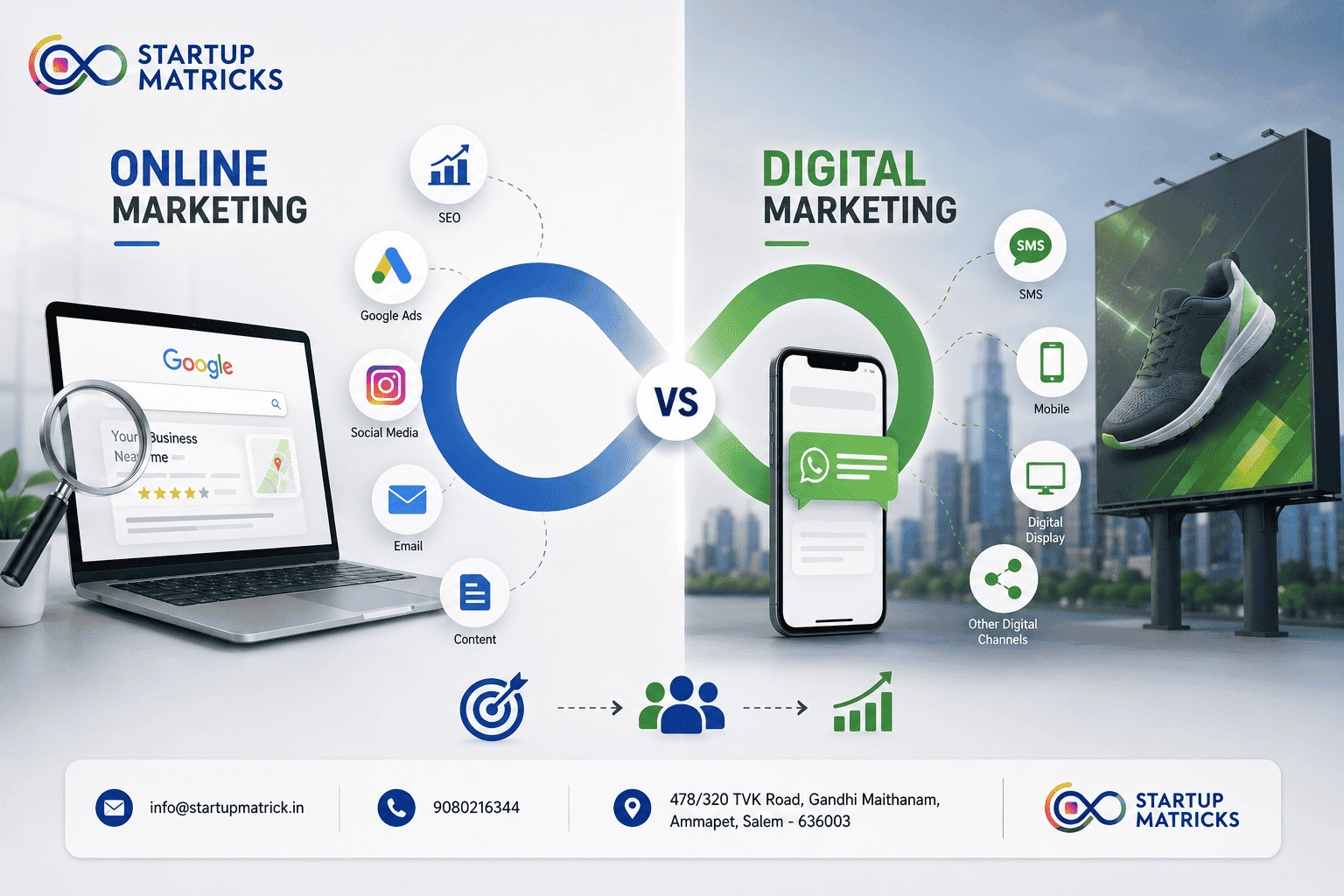
Online marketing refers specifically to marketing activities that use the internet to reach customers. Examples include SEO, Google Ads, social media marketing, email marketing, and content marketing.
Digital marketing is a broader term. It includes online marketing as well as digital channels that do not necessarily require an internet connection, such as SMS marketing, digital billboards, and some forms of electronic advertising.
In simple terms: Online marketing is a part of digital marketing.
What Is Online Marketing?
Online marketing is the process of promoting products, services, or brands through internet-based channels.
The goal is usually to attract visitors, generate leads, increase sales, or build relationships with customers.
Common online marketing channels include:
- Search engine optimization (SEO)
- Google Ads and PPC
- Social media marketing
- Email marketing
- Content marketing
- Influencer marketing
- Affiliate marketing
- Online marketplaces
- Website marketing
For example, a Salem-based clothing store could use SEO to appear in Google Search, Instagram to showcase products, and Google Ads to attract customers searching for clothing stores nearby.
What Is Digital Marketing?
Digital marketing covers a wider range of marketing activities that use digital technology.
Online marketing falls within digital marketing, but digital marketing can also include channels that aren't strictly internet-based.
Examples include:
- SEO
- Google Ads
- Social media marketing
- Email marketing
- SMS marketing
- Mobile marketing
- Digital displays
- Digital billboards
- Marketing automation
- App-based marketing
The exact definition can vary across the industry, but the key distinction is the scope: digital marketing is the broader category.
Online Marketing vs Digital Marketing: Key Differences
The main difference is the technology and channel being used.
Online marketing depends on an internet connection. Digital marketing focuses more broadly on digital technology.
Consider this example:
A business sends promotional messages through email. That's online marketing and digital marketing.
If a business sends promotional SMS messages to customers, it is generally considered digital marketing, but it isn't necessarily classified as online marketing.
This distinction becomes useful when businesses are planning their overall marketing strategy.
How Is Online Marketing Different From Traditional Marketing?
Traditional marketing generally uses offline channels such as:
- Newspapers
- Magazines
- Television
- Radio
- Billboards
- Flyers
- Direct mail
Online marketing uses internet-based platforms.
This doesn't mean online marketing is always better. The right choice depends on the audience, budget, business model, and marketing objective.
Online Marketing for Small Businesses
Online marketing can be particularly useful for small businesses because many channels allow businesses to start with relatively controlled budgets.
A local business could combine:
- Local SEO to appear in local searches
- Google Business Profile optimization to improve local visibility
- Social media to engage customers
- Google Ads to generate targeted traffic
- Content marketing to answer customer questions
- Email marketing to retain existing customers
For example, a local salon could publish useful hair-care content, optimize its Google Business Profile, and run location-focused search campaigns to reach potential customers.
The important point is not to use every channel. Start with the channels where your customers are most likely to spend time.
Which Is Better: Online Marketing or Digital Marketing?
There isn't a universal winner because online marketing is already part of digital marketing.
The better question is:
Which marketing channels are most appropriate for your business goals?
A startup looking for organic traffic may prioritize SEO and content marketing.
An ecommerce business may combine SEO, Google Ads, Meta Ads, email marketing, and remarketing.
A local business may focus on Local SEO, Google Business Profile optimization, social media, and location-based advertising.
Your strategy should be based on your audience, objectives, budget, and measurable results rather than the label used for the marketing approach.
Common Mistakes to Avoid
- Treating online marketing and digital marketing as completely unrelated strategies
- Trying to use every available marketing channel
- Choosing channels without understanding the target audience
- Focusing only on traffic instead of conversions
- Running campaigns without tracking results
- Expecting immediate results from long-term channels such as SEO
Frequently Asked Questions
Is Online Marketing the Same as Digital Marketing?
Not exactly. Online marketing focuses specifically on internet-based marketing channels. Digital marketing is broader and can include online marketing plus digital channels such as SMS and certain digital advertising formats.
Which Is Better for Small Businesses?
Online marketing can be a practical starting point because small businesses can use channels such as SEO, social media, Google Business Profile, and paid search to reach specific audiences and measure performance.
Is SEO Online Marketing or Digital Marketing?
SEO can be classified as both. It is an online marketing technique because it operates through search engines, and it is also part of the broader digital marketing category.
Is Social Media Marketing Online Marketing?
Yes. Social media marketing is generally considered online marketing because it uses internet-based social platforms to reach and interact with audiences.
Is Digital Marketing Better Than Traditional Marketing?
Neither is automatically better. Digital marketing provides detailed measurement and targeting options, while traditional channels can still be useful for businesses trying to reach specific offline audiences.
Can a Business Use Both Online and Traditional Marketing?
Yes. A business can combine SEO, social media, and paid advertising with offline methods such as events, print advertising, or local promotions. An integrated strategy can help businesses reach customers through multiple channels.
Conclusion
The simplest way to understand online marketing vs digital marketing is that online marketing focuses on internet-based activities, while digital marketing covers a broader range of digital channels.
For most modern businesses, the important decision isn't choosing one term over the other. It is identifying the channels that match your customers, goals, budget, and conversion opportunities.
If your business needs support with SEO, paid advertising, or digital growth strategies, Startup Matricks helps businesses develop practical digital marketing strategies based on their goals and target audience.