
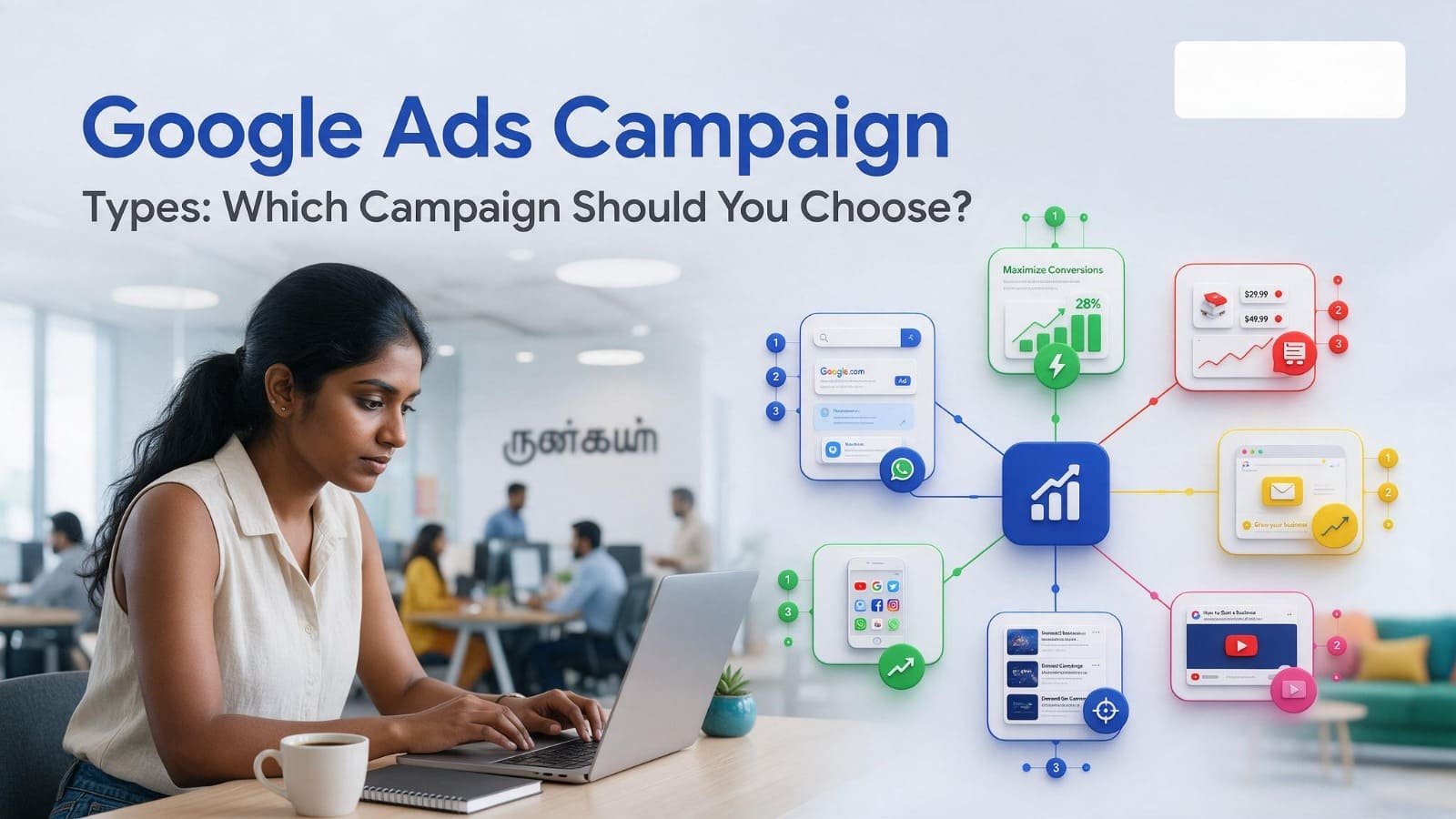
Google Ads Campaign Types: Which Campaign Should You Choose?
By Startup Matricks Team
Contributor

Choosing the wrong Google Ads campaign can waste budget before you generate meaningful results. A local business looking for phone calls does not need the same campaign setup as an ecommerce store trying to increase online sales.
Google Ads offers several campaign types, each designed for different marketing goals. Understanding how they work can help you choose the right campaign based on your audience, budget, website, and conversion goals.
Quick Answer
The main Google Ads campaign types include Search, Performance Max, Display, Shopping, Video, App, Demand Gen, and Local campaigns.
The right choice depends on your objective:
What Are Google Ads Campaign Types?
Google Ads campaign types determine where your ads appear, who sees them, and how Google optimizes your advertising budget.
For example, Search campaigns show ads when people actively search for relevant terms. Shopping campaigns display products with information such as images, prices, and store details.
Your campaign should therefore match the stage of the customer's buying journey.
1. Search Campaigns
Search campaigns are one of the most useful options for businesses that want to reach people actively searching for their products or services.
For example, someone searches for "SEO company in Salem." A relevant business can appear among the sponsored search results.
Search campaigns are particularly useful for:
- Service businesses
- Local businesses
- B2B companies
- Lead generation
- High-intent searches
- Appointment or enquiry generation
Example: A digital marketing company could target searches related to SEO services, Google Ads management, or web development.
2. Performance Max Campaigns
Performance Max allows advertisers to reach customers across multiple Google properties from a single campaign.
Depending on the campaign and available inventory, ads can appear across channels such as Search, YouTube, Display, Discover, Gmail, and Maps.
Performance Max can work well when you have:
- Clear conversion goals
- Reliable conversion tracking
- Sufficient creative assets
- Ecommerce products or lead-generation goals
However, it provides less manual control than traditional Search campaigns, so accurate conversion tracking becomes especially important.
3. Shopping Campaigns
Shopping campaigns are designed mainly for ecommerce businesses.
Instead of relying only on text ads, Shopping ads can display product information directly in Google's shopping experiences.
They are useful for businesses selling:
- Clothing
- Electronics
- Beauty products
- Home products
- Other physical products
A well-structured product feed is important because Google uses product information to understand and display your products.
4. Display Campaigns
Display campaigns help businesses reach people across websites, apps, and other Google Display Network placements.
They are often useful for:
- Brand awareness
- Remarketing
- Product visibility
- Supporting longer buying journeys
For example, a visitor who viewed your service page but did not enquire could later see a relevant display advertisement.
Display generally works differently from Search because users may not be actively looking for your product at that moment.
5. Video Campaigns
Video campaigns allow businesses to advertise through video inventory, particularly on YouTube.
They can be useful for:
- Product demonstrations
- Brand awareness
- Educational content
- Customer stories
- Video remarketing
A strong video campaign needs more than targeting. The creative itself needs to communicate the message quickly.
6. Demand Gen Campaigns
Demand Gen campaigns are designed to create interest and consideration using visually engaging formats across Google's consumer-facing properties.
They can be useful when your goal is to reach potential customers before they search directly for your product.
This makes Demand Gen different from Search.
Search captures existing intent, while Demand Gen can help create or develop interest.
7. App Campaigns
App campaigns are designed for businesses that want users to install or interact with a mobile application.
Common objectives include:
- App installs
- User engagement
- In-app actions
For example, a food delivery app might use app advertising to acquire new users and encourage existing users to return.
How Do You Choose the Right Google Ads Campaign?
Start with the business objective, not the campaign name.
Ask:
- Do I need leads from people actively searching?
- Do I sell physical products online?
- Do I need brand awareness?
- Do I want to remarket to previous visitors?
- Do I have enough conversion data for automated bidding?
- Do I have quality images or video assets?
- Can I track conversions accurately?
A local service business may start with Search, while an ecommerce company may prioritize Shopping and Performance Max.
Common Mistakes to Avoid
Choosing a Campaign Based Only on Popularity
A popular campaign isn't automatically the right campaign for your business.
Tracking the Wrong Conversions
If Google receives poor conversion signals, automated optimization can work toward the wrong outcome.
Sending Every Ad to the Homepage
Your landing page should match the user's search intent and advertisement.
Ignoring Search Intent
High-intent keywords often require a different strategy from awareness-focused advertising.
Changing Campaigns Too Frequently
Constant changes can make performance difficult to evaluate and may interfere with the learning process of automated bidding systems.
Best Practices for Google Ads Campaigns
A strong Google Ads setup usually starts with:
- Clear conversion goals
- Relevant keyword research
- Focused ad messaging
- High-quality landing pages
- Accurate conversion tracking
- Appropriate bidding strategies
- Negative keyword management where applicable
- Regular performance analysis
Don't judge a campaign only by clicks. Look at conversion rate, cost per conversion, conversion value, CPC, CTR, and ROAS when those metrics are relevant to your objective.
Frequently Asked Questions
Which Google Ads campaign is best for beginners?
Search campaigns are often a practical starting point for businesses with clear, high-intent searches because advertisers can build campaigns around specific keywords and user needs. The best choice still depends on the business objective and available conversion data.
Which Google Ads campaign is best for ecommerce?
Shopping and Performance Max are commonly used by ecommerce businesses. Shopping provides product-focused advertising, while Performance Max can distribute ads across multiple Google channels based on conversion goals.
What is the difference between Search and Performance Max?
Search campaigns primarily focus on search intent and provide more direct control over keywords and search queries. Performance Max uses Google's automation to reach potential customers across multiple Google channels.
Is Google Display Ads good for lead generation?
Display can support lead generation, particularly through remarketing and awareness campaigns. However, businesses should compare lead quality and cost against Search and other acquisition channels.
How much should a business spend on Google Ads?
There is no universal budget. Start with an amount you can measure comfortably, then evaluate conversion volume, cost per conversion, lead quality, and return before scaling.
Should I use one Google Ads campaign or multiple campaigns?
It depends on your products, services, locations, audiences, and goals. Separate campaigns can make sense when different groups require different budgets, targeting, messaging, or conversion objectives.
Conclusion
The best Google Ads campaign is not necessarily the newest or most automated option. It is the campaign that matches your business objective, customer intent, conversion data, and available creative assets.
Search is often suitable for capturing existing demand, Shopping is useful for ecommerce products, while Performance Max, Display, Video, and Demand Gen can support broader customer journeys.
Before spending more, make sure your conversion tracking and landing pages are working correctly. If you need help planning SEO, Google Ads, or other digital marketing activities, Startup Matricks can help businesses build data-driven digital marketing strategies based on their specific goals.